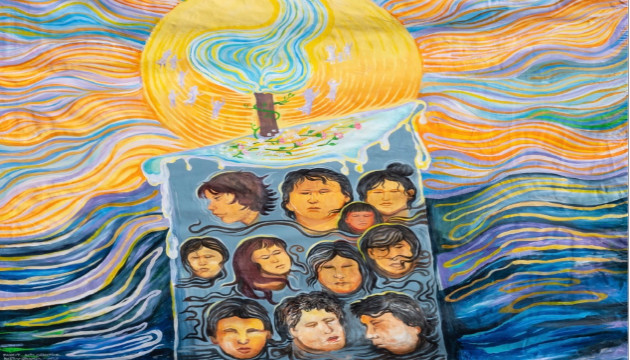
March 1, 2026 — What started as a group of strangers finding community in a non-paying arts workshop turned into a refuge for some still reeling from the tragedy that was the Lapu-Lapu festival in April of 2025.
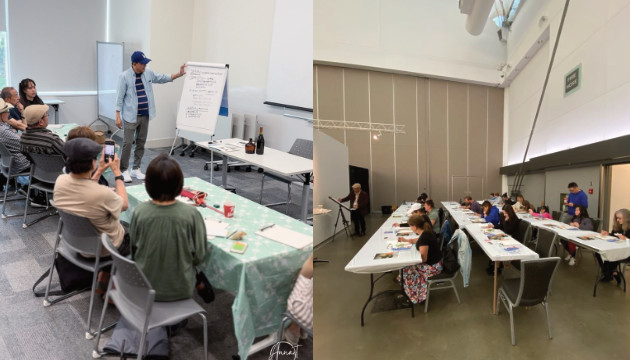
The PANCIT (Philippine Artists Network for Community Integrative Transformation) Art Collective was born out of a 2012 arts workshop facilitated by visual artist and art educator Bert Monterona with co-founders Erie Maestro, Mylene Maranoc and Leonora Angeles. It has since served as the arts and culture arm of Migrante BC, a grassroots organization advocating for migrant rights and welfare.
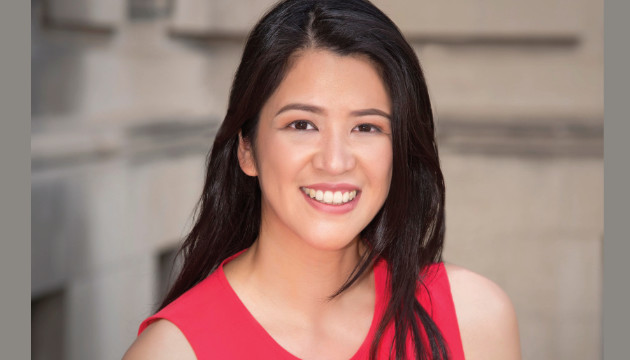
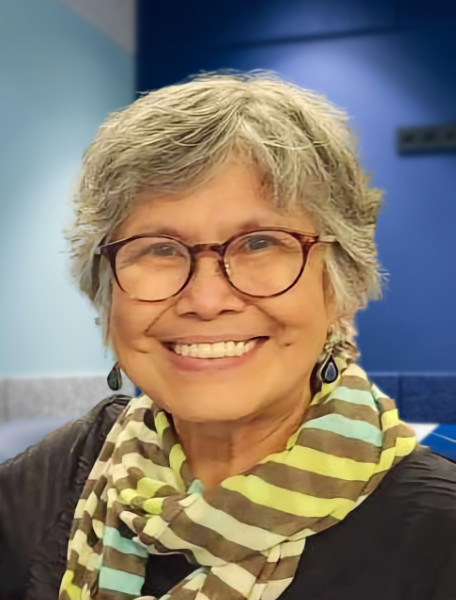 Erie Maestro is a retired librarian and archivist who co-founded both PANCIT Art Collective and Migrante BC.
In an exclusive with Canadian Filipino Net (CFNet), Maestro recounted that at that time, “art as therapy” was not known to them.
“That first group of participants were members of Migrante BC, their friends and a majority were caregivers under the LCP (Live-in Caregiver Program).”
It was only after seeing the effect the workshop had on the participants that they realized that a workshop on art and drawing could be therapeutic.
“It wasn’t just skills-building like producing a mural that we all worked on, but a large part of the workshop sessions is sharing where we all came from,” recalled Maestro. “When we talk of our migration journey, it doesn’t start with when we arrived in Canada, but where we came from - not just the Philippines but Saudi Arabia and Hong Kong. We all shared very complex migration journeys.”
Maranoc explained that the workshops, while still based on skills development, is “used to facilitate emotions and ignite happiness and satisfaction when they have created something they don’t expect.”
One participant claims that the process of doing the workshop and participating in the mural came through strongly for her because she now can explain to her child why she’s in Canada. Maestro explained, “It was difficult for her to say that she left her child because she needed to work.” The participant’s expression through art spoke on her behalf.
Describing the evolution of the annual art workshops as organic, Maestro said that participants of the first workshop truly connected. “In fact, after the workshop, we didn’t want to go our separate ways. We asked ourselves if we can organize ourselves and be together again - and that’s how the PANCIT Art Collective came to be. It was a natural growth of people coming together and not wanting to leave each other’s company.”
Fast forward to 2025 reeling from the Lapu-Lapu tragedy, the organizers came together and decided to slightly pivot to the needs of the Filipino community in the face of trauma. “These projects are usually done in the summer but when the tragedy happened, it took on a different context but it fell right into place.”
A series of weekend sessions beginning in May 2025 culminated in an exhibit called Healing Colours Art Exhibit 2025 ran from October 24 to November 30.
The entire project, both the workshop sessions and culminating exhibit, were “not only intended for the participants’ mental health wellness but also to break the public emotional barriers as a result of the Lapu-Lapu tragedy,” Maranoc told CFNet. The exhibit created space to talk about healing. “We believe that art can open space for dialogue and provide healing when making art. It helps one express their inner feelings when it’s difficult to talk about it.”
Much work still needs to be done for the Filipino community when it comes to mental health and well-being but art as therapy most certainly plays its part. While talking about mental well-being is not considered a “safe” thing to share, Maestro believes that in the end, a mental health professional “need not speak our language.” They just have to be culturally competent to understand the uniqueness of the Filipino psyche.
A participant who witnessed the carnage attested to how the sessions helped them. Maestro related, “In their own world, the sessions helped take their mind off it (the carnage) so that through the process, they gathered strength for another set of hours, another set of days.”
The workshops follow Monterona’s syllabus which has been a result of his own learned experiences as an artist and art educator in Davao in southern Philippines, where he taught art to children who were victims of human rights violations. Maestro shared that although the workshops follow a syllabus and strict guidelines, organizers have to be extra cautious because they are “dealing with people’s emotions.”
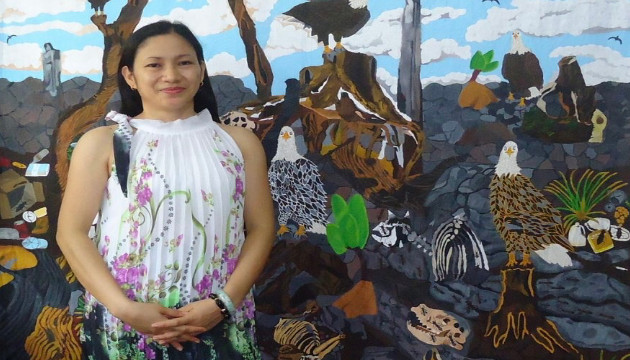 Mylene Maranoc, artist and health worker, is a PANCIT Art Collective co-founder.
“Art as therapy is such an abstract term that doesn’t accurately picture what we do during those workshops,” said Maestro. “What we do doesn’t strictly fall within the concept of art therapy, yet unique because we tend to put our own Filipino ways of looking at things, finding humour sometimes in an almost macabre way and lending peer support counselling without even knowing it.”
She adds that therapy isn’t co-terminus with the workshops nor the exhibit because participants don’t lose their connection with each other. “Whatever support you get there is a gift that keeps on giving.”
Maestro thinks that “kapwa” will eventually make its way to the English dictionary. “If we look at kapwa as our shared identity, our connections with each other, not just within the Filipino community but maybe with each other, everyone can find kapwa in art. In fact, this is good in that it erases the elitist context of art.”
Given that most Filipinos generally are mall- and church-goers, art isn’t considered a “daily routine.” “But kapwa in art makes art accessible - to be shared, to be seen and reflected on.
Public interactive making of art is collective ownership because that mural was created by many.”
From a community that viewed art as elitist, Maestro thinks we have come a long way. “Whenever we see a Filipino artist’s (like Monterona’s) artwork in a public gallery or museum, we’d think: I belong here because he belongs here.”
About the Author
Rachel Ramos-Reid started writing for magazines and newspapers when she was still a junior at the University of the Philippines’ Communication degree program majoring in Journalism. She continued to write in a public relations/corporate communications capacity in various private and government offices until moving out of the country in 1997 to work as Programme Officer for the arts and culture branch of the Southeast Asian Ministers of Education Organization (SEAMEO-SPAFA) in Bangkok, Thailand. At the end of her term, Rachel found herself immigrating to Canada in the year 2000 and again searching for new beginnings.