February 1, 2026 — “We were just there to help,” Donna Aiza Narvaza says. “We didn’t expect to witness something like that. But maybe surviving means we’re meant to remember – and to make sure it never happens again.”
Narvaza spoke these words with tremor, and any listener would break down in tears as she retells the story that haunts not just the victims, families, and friends of the victims, but also many individuals, private and public institutions, and not-for-profit organizations. The story has since graced many online and mainstream broadsheets worldwide – awakening stakeholders to the need for policy revisits and leading to forged and broken ties.
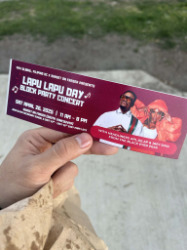 Emir Ryubenn Pamonag shows a ticket for the Lapu-Lapu festival concert.On the evening of April 26, 2025, what was supposed to be a night of music and celebration turned into one of the darkest moments of the Lapu-Lapu Day Festival+ in Vancouver.Around 8:15 p.m., a vehicle plowed into a crowd along 43rd Avenue by John Oliver High School, where hundreds of people – many of them volunteers – had come to enjoy the concert featuring Filipino artists like Apl.de.ap of the Black Eyed Peas. Eleven lives were lost that night. Succeeding days witness the rising number of deaths in hushed testimonies. Many remain in critical condition in various hospitals.
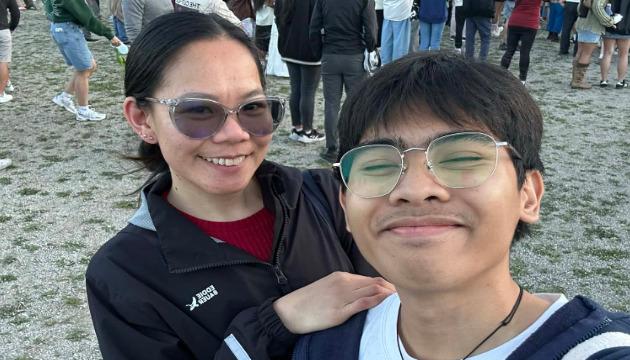
Others, like Narvaza and fellow volunteer Emir Ryubenn Pamonag, confront the challenge of overcoming the trauma of witnessing the event as it unfolded.
Narvaza came to Canada from the Philippines in December 2022 as an international student aiming to earn a second degree – this time, in marketing. Young and friendly as many Filipinos are, she soon warmed up to the community of fellow international students at the Acsenda School of Management (ASM) in Vancouver.
Along with eight other ASM international students, Narvaza volunteered to help at the festival. She was assigned at the concert ticketing booth, proud to support renowned Filipino artist Apl.de.ap of the Black Eyed Peas.
“We were just standing near the food trucks, waiting for a friend who went to the washroom,” she says softly. “Then we heard a loud crash. It was like something heavy had fallen, and then we saw the car speeding toward people.”
Pamonag, 19, and a newly arrived permanent resident, echoes Donna’s recollection,“I was Ate Donna’s ‘plus one’ for the concert [‘Ate’ is a Filipino term for an older girl or woman who is either a sibling or non-sibling]. Prior to the concert, Istrolled along 43rd Avenue, checking out the stalls. Ate Donna introduced me to her friends. After the concert, around 8 p.m., the 10 of us walked the stretch of 43rd Avenue by Oliver High School. It was then that I heard continuous deafening sounds that seemed to be coming from the other end of 43rd Avenue, opposite Fraser Street. The loud and heavy sounds lasted for five minutes.”
Pamonag further says, while trying to quell his tears, that the sound of heavy thuds still rings loud in his ears to this day and he can still hear the cries for help.
The 10 friends were only a few meters away from the impact zone. “Everything happened so fast,” Narvaza continues. “At first, we didn’t realize what was happening. It felt like a movie scene – people screaming, running, others lying on the ground. My friend checked the pulse of someone who had fallen. Nearby, I saw a family – two adults and a small child – trapped under a food truck.”
For the young volunteers, that image still lingers in their minds.
After the chaos, police asked witnesses to remain in the area for questioning. “They invited us to the station,” Narvaza says. “We stayed until past midnight. Everyone was in shock.”
In the days that followed, Narvaza and Pamonag found it difficult to sleep. “I kept hearing the sound of the crash in my head,” shesays. “When I see an ambulance or hear sirens, I get scared. I just try to push the memories away.”
Upon coming home, Pamonag poured his heart out to his parents. Whenever he happens by 43rd Avenue, the heavy thuds ring loud and the bloody scene reappears. Screams of disbelief haunt him still.
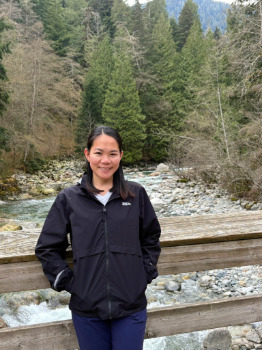 Donna Aiza Narvaza jogs and hikes to heal from the memory of the tragedy.Narvaza’s family in Occidental Mindoro, Philippines called every day to check on her. “My mom would always say, ‘Pray. Don’t think about it too much.’ That helped,” she says.
Prayer and community became her anchors. She and her friends began attending Sunday Masses, joining vigils for the victims, and volunteering for school and charity events. Pamonag’s parents, who are both Vancouver-based, always caution him to stay away from large gatherings held on the streets. And if he does join these events, he has to know the exits to safety.
“Keeping busy helps,” Narvaza reflects. “I go jogging, play badminton, volunteer. Being with friends, praying together – that’s how we heal.”
But the pain has not completely disappeared. The mention of another festival triggers anxiety. “Even if it’s held somewhere else, I don’t think I can go,” she admits. “It’s still too fresh.”
Pamonag, however, welcomes the idea of continuing the Lapu-Lapu Day Festival in 2026. “As Filipinos, we need to connect. I want to connect with my people. This community event happens only once a year.”
Both Narvaza and Pamonag feel anger toward what they perceive as the government’s inadequate response and lack of preventive measures. They have questions that perhaps only the three levels of government could answer.
“Once one has sinned, there should be a complementing punishment. We don’t know what happened to the person. The perpetrator has mental illness. Why did the government allow him to drive? Why can’t the government have a facility for those with mental illness?” Narvaza says,
“There were no real barriers that night, just plastic ones. We didn’t see any police nearby. It wasn’t safe,”Pamonag adds, “We expected cemented solid barriers and street closures just like those they put up for big events. The emergency responders came much later, after the calls to 911. You could see that the area became bloodied. Health care assistants immediately checked who among the victims could survive. In the medical field, time is gold.”
What frustrates them more is how the incident was explained away. “They said the driver had mental illness,” she says quietly. “But that doesn’t bring back the people who died. It feels unfair. They lost their lives, and the law can’t do anything for them.”
Still, Narvaza chooses not to hold on to hatred. Pamonag, on the other hand, feels no compassion for the offender, “I am angry. What he did is infuriating. Why wasn’t his license confiscated? He has already caused several disturbances prior to the festival. Why was he even allowed to drive? We don’t know when his triggers would cost life and limb.”
Still shocked at the thought of that moment when horrified screams echo and bloodied body parts haunt, Narvaza and Pamonag, along with their friends, seem ready to walk the long, painful road toward healing. For the young volunteers, healing is a process of prayer, friendship, and faith. They met friends of friends, became close friends, and found comfort in each other’s healing.
About the Author
As a freelance journalist for over 40 years now, Maria Veronica “Vernie” G. Caparas tackles complex social issues, weaving compelling narratives that spark meaningful conversations. With a keen eye for detail and a knack for human interest stories, she sheds light on underreported stories, amplifying marginalized voices.