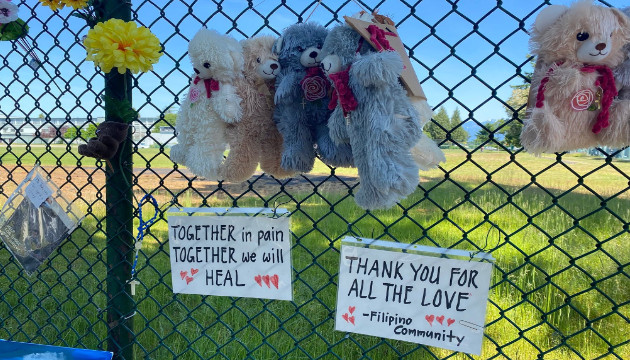
June 16, 2026 — When David Eby declared May 2, 2025 as the official day of remembrance for victims of the attack at Lapu-Lapu festival in Vancouver, the British Columbia premier paid tribute to the community most impacted by the tragedy.
“It is difficult for anyone in British Columbia to not have been touched in some way by a member of the Filipino Canadian community. You cannot visit a school, a daycare, a clinic, a hospital or a long-term care facility in our province and not meet a member of this community,” Eby said in a statement on that day.
Eby continued, “Filipino Canadians have a well-earned reputation as a giving community. Now, it is our turn to give back.”
In recent years, the Philippines has become one of the top sources of immigrants to Canada, allowing newcomers to participate in many aspects of life in B.C. and Canada in general.
But amid growing concerns whether housing supply, infrastructure and public services can keep pace with immigration, Canada has started tightening its doors.
This has left temporary residents like Chrissie Cruz and Jepren Solis wondering how long they can stay. They are hoping that they will not make a difficult decision soon.
“We will cross the bridge when we get there. But we hope we don’t have to,” said Cruz.
The couple is struggling to remain together in Canada, less than two years after they came to Vancouver.
Cruz came to Vancouver in August 2024 as an international student and enrolled in a postgraduate program in political science at the University of British Columbia. Solis followed in January last year under a spousal open work permit (SOWP).
Cruz completed her program in April this year and can continue to stay in Canada for up to three years under a post-graduation work permit (PWGP). The couple hopes to gain permanent resident status before the permit ends.
But under a policy implemented by the Immigration, Refugees and Citizenship Canada (IRCC) starting on January 21, 2025, an SOWP extension is allowed only if the PGWP holder is employed or is offered a position in any of the jobs categorized under training, education, experience and responsibilities (TEER) 0 and 1, or specific TEER 2 or 3 occupations.
TEER 0 jobs include management occupation like advertising, marketing and public relations managers, and financial managers. Those under TEER 1 are occupations usually requiring a university degree such as financial advisors and software engineers.
Employment in these occupations also provide greater chances to qualify for pathways for permanent residency in Canada.
“It has been difficult to find a TEER 0 or 1 occupation, especially under the current situation. But everyday I send job applications,” said Cruz.
The couple’s struggles are shared by other Filipino migrants in British Columbia.
“Filipino migrants across British Columbia are facing mounting uncertainty as Canada’s immigration system undergoes rapid and unpredictable shifts,” according to the Tulay at Gabay 2025: What We Heard Report.
The 24-page report released earlier this year by the University of the Philippines Alumni Association in British Columbia (UPAABC) is part of a “sociopolitical research project documenting the lived experiences, priorities, and aspirations of Filipino communities in British Columbia.”
The report came out from a series of conventions in Vancouver on May 10, 2025 and Victoria on September 20, 2025 that was attended by Filipino migrants and volunteers. UPAABC also conducted a survey on how constantly changing immigration policies were affecting Filipino migrants.
The conventions and survey showed that the shifting immigration policies have narrowed or eliminated viable permanent resident pathways for many Filipino immigrants.
“Many arrived under policies that promised clear pathways from temporary to permanent residency, only to encounter sudden reversals beginning in late 2024. These changes have disrupted long-term plans, strained finances, and created widespread anxiety within the community,” according to the report.
The main concerns of Filipino migrants also include long processing delays for PGWPs, permanent resident applications, and those hired under the Labour Market Impact Assessment (LMIA). The delays have “contributed to job loss, income instability, and gaps in access to essential services for those on temporary or implied status”.
Cruz said that like many Filipino migrants, they are hoping to become permanent residents and turn a new page in their life.
She left her work as a research associate of the Philippine office of an international nonprofit organization to come to Canada. Solis was creative team leader of a graphic design company.
“We are seeking better opportunities and I want to be closer to my family in the United States and Nova Scotia,” said Cruz.
But the past two years have also been a struggle for the couple in trying to meet their needs amid soaring prices of basic commodities.
While studying, Cruz worked as a teaching assistant. Solis took on various jobs including roofing, as a warehouse worker, and in a coffee shop.
“It has been difficult finding a stable and regular job, even with my work permit,” said Solis.
The couple said they at times have wondered how they have continued their stay in Canada despite the daily struggles.
“We have come this far and we will not give up until we have exhausted everything,” said Cruz.
For the couple, this means sending out tens of job applications daily, monitoring job postings, and asking assistance from friends.
The worse scenario is that Cruz fails to get at least and offer for TEER 0 or 1 work and Solis will be ineligible to extend his SOWP. This would mean he has to leave Canada.
But being apart is not an option for the couple. At least, for now.
“We came here together and we want to stay that way and we hope things will work out for us,” said Cruz.
If successful, Cruz and Solis will add their skills and experiences to a giving community whose generosity is deeply ingrained, a spirit embodied in its values of bayanihan (community cooperation) and damayan (solidarity).

About the Author
Nestor Burgos is a former reporter and chief of correspondents for the Visayas of the Philippine Daily Inquirer. He was also former national chairperson of the National Union of Journalists of the Philippines. He continues to be a freelance journalist writing mostly on the Filipino-Canadian community, particularly in British Columbia.