
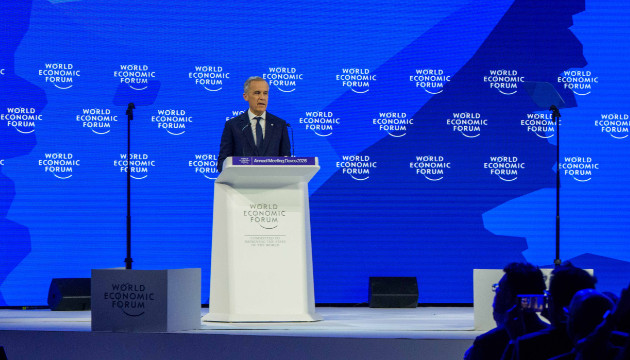
March 1, 2026 – At the World Economic Forum in Davos PM Mark Carney delivered on January 20, an extraordinary 16-minute speech defining a new world order led by middle power countries. The speech that shook the world and earned a rare standing ovation from the world’s most powerful political and business leaders at the WEF soon changed the global trade and economy landscape.
The Canadian Prime Minister’s speech was followed the next day by President Trump who rumbled on for an hour-and-a- half about America’s greatness and his success in making it so which were received with yawns by a visibly bored audience, according to a delegate who was at the meeting.
Enraged that he was upstaged in Davos by PM Carney who had been ignoring his early morning social media tweets and insults, Trump asked Carney for a meeting at the White House in early February. Surrounded by his cabal of yes men, he presented Carney with five demands and threatened to increase tariffs on all Canadian goods if the PM refused to submit. The PM calmly and firmly said No, turned his back on Trump and walked out of the White House to the disbelief of Trump and stunned sycophants. The message: Canada will not beg.
Canada partners with EU and CPTPP
In the past six months PM Carney, using his personal connections worldwide from his years as central banker, had been quietly using pen and phone to negotiate with the UK, France, Germany, Australia, and Japan –all staunch allies of the US– to build a diplomatic and economic coalition in a new world without the United States. All five countries agreed to support him.
On Feb. 17, Carney announced at a press conference that Canada had signed a partnership with the European Union to ship Canadian oil, gas, hydro power and critical minerals to the EU instead of the US. The $220billion agreement removed Canada’s dependence on US trade and bypassed its dollar-dominated trade system. The US stock market went red. Currency market saw high volatility and the US dollar dipped while gold surged to over $6,000 per ounce. Sensing uncertainty China dumped $400 billion in US bonds.
Then Trump imposed a 2% tax on foreign investors for using American banks. The four big banks – JP Morgan, Bank of America, City Group, and Goldman Sachs – refused to pay Trump’s tax and abandoned Wall Street; trillions of dollars flowed from New York to Toronto because Canada was seen as safe, predictable, and stable with a PM who stands for resilience and resistance against Trump. On Feb 19 Toyota announced it would shift $9 billion investment from the US to Canada.
After PM Carney’s short visit in January, India’s PM Modi signed a $200 billion resource pact with Canada. Brazil also signed a $270 billion resource pact focused on natural resources with Canada to be conducted in their respective national currencies thus circumventing the US dollar. Both India and Brazil were under economic pressure from Trump and chose to side with Canada.
In addition, Canada is bridging the EU and Indo Pacific Club, known as CPTPP trade blocs (Comprehensive and Progressive Agreement for Trans-Pacific Partnership) resolved last November to combine their economic forces to push back on the fragmentation of free trade in the wake of Trump’s “Liberation Day” tariffs on every country in the world. (On Feb. 20 the US Supreme Court ruled that Trump’s tariffs policies were illegal and that the $175 million already collected must be refunded with the lower courts to decide the process.)
Countries in Carney’s 40-nation coalition to intertwine the supply chains of members include Canada, Singapore, Mexico, Japan, Vietnam, Malaysia, South Korea, Thailand, New Zealand and Australia and Europe, excluding the United State. It is a new trading bloc of 1.5 billion people with a combined GDP of 28 trillion dollars. It brings 40 nations on opposite sides of the globe closer together with the aim of reaching a deal on rules of origin, bypassing the US dollar-dominated world trade. These rules determine the economic nationality of a product and would allow manufacturers throughout the two blocs to trade goods and their parts more seamlessly in a low-tariff process called cumulation.
Trump thought he could easily dominate Canada and the world with his tariffs but Carney offered the world a strategic option for smaller economies to create a comprehensive trade alliance while freezing out Trump’s America from the new world order. And countries from four continents flocked to join the world’s largest alignment of trade and economic cooperation ever assembled. Carney did it so quietly, speedily, and brilliantly that it was immediately operational and totally blindsided Trump and his trade advisers who thought they already had the world by its throat with their bullying trade policies.
Canada’s Asia and Indo-Pacific pivot
On February 26, 2026, PM Carney left for India, Australia, and Japan to reduce Canada's economic dependence on the United States. The stakes are enormous: $70 billion in new trade with India, historic parliamentary address in Australia, and strategic partnerships inTokyo—but this isn't just about trade deals.
Canada is positioning itself as the supplier of energy, oil, uranium, natural gas and critical minerals to the entire developing world with India as the gateway for South Korea, Singapore, Vietnam, Thailand and other ASEAN countries to join and diversify their supply chains away from their Chinese and Russian suppliers.
At the G20 summit last year, Canada, India, and Australia formed a technology and innovation partnership called AID where Australia, India, and Canada, are pooling their resources to develop artificial intelligence, nuclear energy tech, and critical mineral supply chains and they're doing it without the United States.
In addition, Australia, Japan, South Korea, and increasingly Canada are forming what some analysts are calling the Quad Plus. It's a defense and economic alliance specifically designed to counter both Chinese aggression in the South China Sea and American unpredictability. Australia has lithium, rare earths, cobalt. Canada has uranium, graphite, nickel. Together, they can control a significant portion of the global supply chain for batteries, nuclear energy, and advanced electronics.
With all these resources available in the 40-nation coalition led by PM Carney, when the CUSMA comes up for review in July, Canada can walk into those negotiations and say to the US, "We don't need this deal as badly as you think we do." Will the US blink and offer reasonable terms? Trump with current 39% approval rating may not even be at the table by then. Can a middle power successfully decouple from a superpower while under active economic pressure?
We will know the answer in five months.
Editor of Canadian Filipino Net
Eleanor R. Laquian has written four bestselling books and co-authored four others with her husband, Prod Laquian. Over ten years, she served in various capacities at the University of British Columbia’s Institute of Asian Research: as manager of administration and programs, editor and chair of the publications committee, and primary researcher of its Asian Immigration to Canada project.
She did her BA degree in journalism at Maryknoll College in the Philippines, a master’s degree in public administration at the University of the Philippines, and postgraduate studies at the School of Public Communications at Boston University in the US.
Before immigrating to Canada, she worked with the UN Food and Agriculture Organization, the World Health Organization, and the UN Information Center. She was a researcher and bureau manager of The New York Times in Beijing, China from 1984 to 1990. She was the first and only Filipino to conduct a nationwide survey of Filipinos in Canada, in 1972, for her master’s thesis at UP. It was published as A Study of Filipino Immigrants in Canada, 1952–1972.
She updated the survey in 2005 for a book, co-authored with her husband Prod: Seeking a Better Life Abroad: A Study of Filipinos in Canada, 1957–2007,published by Anvil Publishing in Manila. She and Prod have visited over a hundred countries for work and pleasure. They immigrated to Canada in 1969.