

February 1, 2026 – On Tuesday, January 20, PM Mark Carney delivered a 16- minute speech at the annual World Economic Forum in Davos, Switzerland, before the world’s most powerful political and business leaders and shook the millions watching it on TV around the globe.
PM Carney said that “the rule-based world order we knew since 1945 is dead and not coming back.” That we should “not mourn its passing because nostalgia is not a strategy.” That we now “must face the world as it is and not as what we wish it to be.”
With these direct, provocative, and stirring words delivered calmly, clearly and seriously like an adult speaking to a wayward teen, he continued to define a new world order as where “like-minded middle powers like Canada can band together to push their own priorities rather than negotiate bilaterally with hegemon that uses trade and tariff as weapons to bully others into submission.”
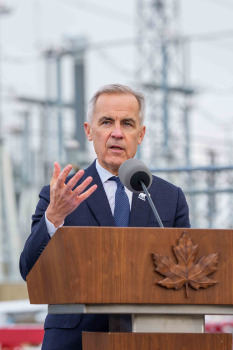 Canadian Prime Minister Mark Carney. Photo by Office of the Prime Minister.
Speaking like Canada’s #1 Salesman, he told the World Economic Forum that “Canada has what the world wants, citing energy, critical minerals, an educated population, strong pension funds and a government with immense fiscal capacity to act decisively. And pragmatic in recognizing that progress is often incremental, that interests diverge, that not every partner will share our values. So we are engaging broadly, strategically, honestly and with open eyes. And we have the values to which many others aspire.
“Canada is a pluralistic society that works. Our public square is loud, diverse and free. Canadians remain committed to sustainability.
“We are a stable and reliable partner in a world that is anything but. A partner that builds and values relationships for the long term.
“And we have something else. We have a recognition of what's happening – that we are in the midst of a rupture, not a transition, that great powers are using economic integration as weapons, tariffs as leverage, financial infrastructure as coercion, supply chains as vulnerabilities to be exploited – and we have a determination to act accordingly.”
PM Carney ended his short speech with “That is Canada’s path. We choose it openly and confidently. And it is a path wide open to any country willing to take it with us.” As he said earlier “middle power must act together because if we are not at the table, we are on the menu.”
On his return to Canada from Davos, Prime Minister Mark Carney on Monday, January 26, took major steps to build a stronger economy and make life more affordable for Canadians. To achieve this, he said “we are strengthening trade and investment partnerships abroad and supporting growth at home – creating good career opportunities with higher wages.”
He introduced new measures to make groceries and other essentials more affordable, helping Canadians put more money back in their pockets
Putting more money back in Canadians’ pockets
- Canada Groceries and Essentials Benefit: Increased by 25% for five years starting July 2026, plus a one-time payment equivalent to a 50% increase this year.
- Families of four could receive up to $1,890 this year, and about $1,400 annually for the next four years. Single Canadians could receive up to $950 this year.
Tackling food insecurity, supporting producers, and strengthening supply chains
- Supporting Food Security: $500 million through the Strategic Response Fund and $150 million Food Security Fund to help businesses manage supply chain costs and support local food production.
- Immediate Relief for Families: $20 million for local food banks and infrastructure ensures more nutritious food reaches families in need.
- National Food Security Strategy: Includes measures such as unit price labelling and strengthened monitoring of competition in food supply chains.
These measures build on the government’s ongoing efforts to make housing, school meals, and transportation more affordable, while strengthening Canada’s economy and food system for the future.
Editor of Canadian Filipino Net
Eleanor R. Laquian has written four bestselling books and co-authored four others with her husband, Prod Laquian. Over ten years, she served in various capacities at the University of British Columbia’s Institute of Asian Research: as manager of administration and programs, editor and chair of the publications committee, and primary researcher of its Asian Immigration to Canada project.
She did her BA degree in journalism at Maryknoll College in the Philippines, a master’s degree in public administration at the University of the Philippines, and postgraduate studies at the School of Public Communications at Boston University in the US.
Before immigrating to Canada, she worked with the UN Food and Agriculture Organization, the World Health Organization, and the UN Information Center. She was a researcher and bureau manager of The New York Times in Beijing, China from 1984 to 1990. She was the first and only Filipino to conduct a nationwide survey of Filipinos in Canada, in 1972, for her master’s thesis at UP. It was published as A Study of Filipino Immigrants in Canada, 1952–1972.
She updated the survey in 2005 for a book, co-authored with her husband Prod: Seeking a Better Life Abroad: A Study of Filipinos in Canada, 1957–2007,published by Anvil Publishing in Manila. She and Prod have visited over a hundred countries for work and pleasure. They immigrated to Canada in 1969.