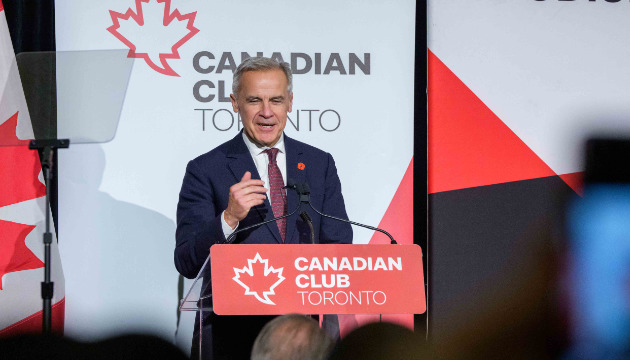
February 1, 2026 — When Prime Minister Mark Carney received a standing ovation from the assembled record numbers of global leaders in academia, business, diplomacy, government, media and politics after delivering his Special Address at the Plenary Session of the 56th Annual Meeting of the World Economic Forum in the picturesque Alpine town of Davos in Switzerland on Tuesday January 20, 2026 – apparently a rare occurrence in that setting – Canada wrote in granite its global leadership in the annals of Canadian and world history! A shining moment, indeed. Carney’s historic speech inspired and led middle-power nations argue successfully that the “armor” of the old U.S. superpower-led rules-based order no longer fits the modern world.
The feared geopolitical and geoeconomic global crisis was averted. No gunshot was heard. And Trump retreated on his menacing threats of Greenland purchase or conquest and, instead, took the off-ramp – a new framework of Arctic security – offered by the North Atlantic Treaty Organization (NATO) Secretary General Mark Rutte.
The events unravelled much like the biblical story of David and Goliath where young diminutive David refused King Saul’s heavy metal armor because it did not fit him and, instead, used a hand sling with one smooth tennis-ball size stone gathered from a river stream that landed into the forehead of giant-size Goliath, and won.
WEF and NATO – Common Cause
The World Economic Forum was founded in 1971 by Swiss-German economist Klaus Schwab “to discuss pressing global issues and find common cause for security and institutional cooperation, economic interdependence, and shared rules” and, thereby, “foster enduring peace and prosperity.” As a private group, it has functioned as a think-tank and produced vital reports such as The Global Risks Report 2026 21st Edition – Insight Report, which must have caused, in part, record numbers of private and public global leaders, including American President Donald Trump and Canadian Prime Minister Mark Carney, to come to Davos 2026.
The Forum’s mission to find common cause for world peace complements the vision of NATO to deter war. Formed on April 4, 1949 and ratified officially as a treaty on August 24 that same year by the 12 founding nations – Canada and United States from North America and Belgium, Denmark, France, Iceland, Italy, Luxembourg, Netherlands, Norway, and United Kingdom from Europe – NATO with its nearly 77-year timespan of alliance has proved its worthiness as an instrument of peace and prosperity for its 32 members and beyond.
Articles 4 and 5 are its two cardinal treaty provisions that are relevant to the subject explored here. Article 4 – the ‘consult’ article – provides the mechanism for members to bring security concerns for discussion before they escalate into an armed attack. It was not invoked in the situation just faced and ended, with relief. Article 5 – the ‘defend’ article – enshrines the principle of collective self-defence, that is, an ‘armed attack’ against one member is considered an attack against all members, and each member must assist the party attacked, including with the use of armed force.
The Imminent Threats Preceding the Forum
The Forum has now concluded and the world can now breathe a sigh of joy, knowing that the principled audacity of middle power nations like Canada has triumphed over the audacity of coercive superpower.
But imagine, in light of Articles 4 and 5, the stress to allies and the existential threat to NATO itself created by Trump’s Greenland gambit prior to the Forum.
Trump’s incessant threats to annex Greenland – Denmark’s semi-autonomous territory of 57,000 citizens, of whom 89 percent are Greenlandic Inuit – with use of military force if need be plus the threats of punishing tariffs made for a truly weird and unfathomable behaviour coming from a NATO member. They were disrespectful of Greenlanders and Danes as they were unconscionable.
All these were unnecessary, to say the least.
Perhaps, perhaps as an upside, the whole experience may serve as foundational blueprint for a more stable and predictable new rules-based world order has appeared on the horizon.
The Carney Pivot – Middle Power Solidarity
Using an age-old culturally shared proverb, Carney issued eloquently a rallying cry: “The middle powers must act together because if we're not at the table, we're on the menu.” A vivid political metaphor that if you are not a participant in the decision-making process, you are likely to be the victim of those decisions. [see related Op-Ed by ER Laquian].
Carney articulated a ‘values-based realism’ strategy for middle power nations like Canada, France and Germany to avoid being ‘on the menu’ and subject to the old rules. That middle power nations with still significant influence must take collective action to protect each other from coercive diplomacy and avoid being exploited or "eaten" by the superpowers. To acknowledge that influence in international relations is increasingly determined by military capacity, market size and the impunity to dictate terms. To discern that the traditional multi-lateral rules-based system like the World Trade Organization is increasingly becoming ineffective and replaced by a "might-makes-right" approach where large economic blocs use their ‘might” as weapons.
And, therefore, he argued, to move to diversify their trade and security partners so they are not overly dependent on any one superpower. To build enough collective bargaining power to demand fair terms from the superpowers rather than having those terms dictated to them unilaterally, where no single superpower can unilaterally have its way through tariff threats alone or, alternatively, threats of military conquest.
Audacity of Principle over Audacity of Power
It is hoped the World Economic Forum 2026 constitutes the consensus that the sovereignty of the small and middle power nations holds firm, that humanity’s highest values are not for sale at any price.That the "triumph of audacity" would not be the triumph of the bully, but the triumph of the noble spirit—proving that in 2026, the pen of the treaty and the voice of the people remain mightier than the sword of the tariff. That this moment serves as a "pivotal cure" for political madness. Then, Davos 2026 will be remembered for the triumph of principled audacity over coercive power.
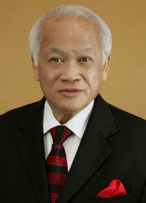
Editor's note: Dr. Rey D. Pagtakhan, P.C., O.M., LL.D., Sc.D., M.D. M.Sc. is a retired lung specialist, professor of child health, and former MP, Parliamentary Secretary to the Prime Minister, and cabinet minister. He graduated from the University of the Philippines, did postgraduate training and studies at the Children’s Hospitals of Washington University in St. Louis and the University of Manitoba in Winnipeg, and spent a sabbatical year as Visiting Professor at the University of Arizona Medical Center. He is the author of articles and chapters in medical journals and textbooks and columnist for community newsmagazines. Widely lectured in Canada and abroad, he spoke in June 2003 on “The Global Threat of New Infectious Diseases” at the G-8 Science Ministers/Advisors Carnegie Group Meeting in Berlin. He volunteers on the Advisory Council of Immigration Partnership Winnipeg and the Board of St. Paul’s College Foundation at the University of Manitoba.