October 1, 2026 — “The Philippines is a very young nation… with a very old history, and the complicated story of how the Philippines came to be can be told partly from old maps.”
So said Filipino historian, academic, and journalist Ambeth R. Ocampo at the culminating event of his British Columbia lecture tour. The engaging and well-received presentation was held in Downtown Vancouver on September 25, following successful lectures at Simon Fraser University and University of Victoria.
Ocampo’s presentation, entitled "Maps and the Emergence of the Filipino Nation”, dove into historic 16th to 21st century cartography, the evolution of the shape of the archipelago, and how maps both define and connect nations by what is shown and not shown.
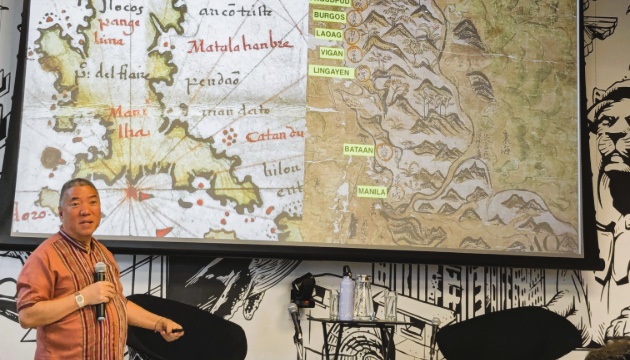 Historian Ambeth Ocampo delivered an engaging talk in Downtown Vancouver.
He presented a series of historical maps, including the famous 1734 map created by Jesuit cartographer Pedro Murillo Velarde, Filipino engraver Nicolás de la Cruz Bagay, and Filipino artist Francisco Suárez.
This map has been called the country’s first and most important scientific map and the “mother of all Philippine maps.” Ocampo explained how this map famously helped the Philippines assert territorial rights on the South China Sea.
He also expounded on vignettes on the map showing different nationalities in Manila in the 18th Century - Armenians, Mongols, Indian mariners, and even cafres or East Africans whose presence offered a glimpse into the little-known Pacific Slave Trade.
Ocampo concluded his lecture declaring how, historically, maps claimed empire: “old maps were made by the European colonial powers to claim territory and… the maps that we use today gives Filipinos or the people represented on the map a sense of national identity.”
Before Ocampo’s presentation, Philippine Consul General Gina A. Jamoralin welcomed attendees, acknowledging that the lecture was part of a week of activities celebrating the Maritime and Archipelagic Nation Awareness Month (MANAMO) and the 10th Anniversary commemorations of the 2016 South China Sea Arbitral Award rendered by the Arbitral Tribunal and settled under the United Nations Convention on the Law of the Sea (UNCLOS).
Professor Kai Ostwald, Director of the Institute of Asian Research and an associate professor at the University of British Columbia, moderated discussions after. The event was held in partnership with the Asia Pacific Foundation of Canada, and the Philippine Consulate General in Vancouver.