[Editor’s Note: Dr. Pagtakhan is a retired Professor of Pediatrics and Child Health from the University of Manitoba Faculty of Medicine (1971-1988) and the first Canadian Filipino MP (1988-2004), Parliamentary Secretary to the Prime Minister, and Federal Minister. Widely published and lectured in medicine, politics and community advocacy, his Medisina at Politika commentary is published in Canadian Filipino Net and Pilipino Express.]
As the first anniversary of the April 26 Lapu-Lapu Day tragedy approaches, we must choose between the "speed of resilience" and the "depth of care."
We are exactly eight weeks away from April 26, the first-year anniversary of the Lapu-Lapu Day tragedy that shattered our sanctuary and forever changed the Canadian Filipino community. That is why this milestone is not merely a calendar date. It is a profound psychological threshold for our community and beyond.
Commission of Inquiry
So traumatic was the tragedy that the Province of British Columbia felt “the urgency for guidance on event safety” and promptly established on May 7 the Commission of Inquiry into Community Events Safety, with The Honourable Christopher E. Hinkson, K.C., former B.C. Supreme Court Chief Justice, as the sole commissioner. The study commission reported on June 26 on “measures to protect and strengthen public security and safety at community events.” Released to the public on July 9, the first of six recommendations states: “All public events in British Columbia, regardless of size, should be supported by a risk assessment.” And adds: “…it should be thoughtful, structured, and appropriate to the scale and nature of the event.”
2026 Programming Plans and Risk Assessment
Risk assessment is now at work as it considers Filipino B.C.’s programming plans announced on January 7 for this year’s event. Filipino B.C. – organizers of the Festival – and Kapwa Center have put forward a two-weekend schedule: ‘April 17-19’ for dominantly festival celebrations and ‘April 25-26’for solely memorial gatherings. Said Board Chair RJ Aquino: “We’ve heard loud and clear from the community that they do want to be together…To not celebrate is surrender to fear.”
Aquino’s determination to proceed is understandable. The instinct of civic leaders in the wake of such horror, is often to sprint toward "resilience." Recall that soon after the tragedy, Filipino BC established the Kapwa Center for Community Resilience.
At press time, we have no update on the results of the risk assessment. But when recently interviewed on whether to cancel the festival as called for by families of victims, Aquino replied repeatedly (A. Jung & A. Judd: Global News, Feb 25, 2026): “I have no new information to share regarding LapuLapu Day.” Yet, the same news outlet also reported that it “has confirmed with officials from the Italian Cultural Centre that this year the event will be hosted at their facility.”
Risk assessment of events is about their content and location. For this year’s first anniversary of the tragedy is critically about the risk of re-traumatization of last year’s victims and their families as much as it is about risk to general public security and safety. Changing the venue without changing the content of the planned anniversary event would miss a critical requirement for a “thoughtful” risk assessment. It is bound to engender a further deficit in community trust.
The Reality of Social Friction
A deficit in trust is central to social friction. It fuels it. No wonder that the already turbulent undercurrent of social tension has become increasingly discernible from recent media reports.
It is this trust gap that fuels the three friction points underlying the scope of social friction engendered by the LapuLapu tragedy.
First, Distribution of Kapwa Strong Fund (reportedly $2 million)
Distribution of this Fund between relief for emergency and ongoing health care needs versus long-term endowment at the Vancouver Foundation has been a key source of tension. This friction point has manifested in many ways: 1) call for full independent audit and outcry over fund transparency, 2) questions about financial governance and decision establishing the endowment fund, and 3) heartbreaking calls by victims’ families for more financial help and for cancellation of public celebrations.
Second, Handling of the 2026 Anniversary of LapuLapu Day Tragedy
This is an emotional friction point with many dimensions. Families of the 11 people killed have stated their feelings for more help before moving on to another festival celebration. Others are concerned that a heavy policing presence for safety reason would be intimidating and counterproductive to our community’s welcoming cultural image, and festival celebration may unwittingly minimize the gravity of lives lost. Others still feel that large-scale festival at this time is simply premature, “to much, too soon.”
Third, Push for a Filipino Cultural Centre by Two Groups
While the push for a Filipino Cultural Center at two different sites by two Filipino groups with divided supporters has become a lightning rod for community conflict, its relevance to anniversary-related friction is indirect at best, but assumes greater importance if some of the donor funds have been reserved for the Centre’s infrastructure budget.
It is clear from the foregoing our collective wound is far from knit. Add the revelation of systemic failures within the provincial mental health system with regard to the accused perpetrator, the privacy breach of the victims’ medical records while they were in the hospital, and the looming weight of forthcoming criminal and civil proceedings where testimonies could once more open the wounds of the tragedy – all of which beyond the control of Filipino B.C. – and we begin to more fully comprehend the "traumatic grief" paralyzing our community.
“Traumatic grief can be complicated,” says Melissa Glaser in her book, Healing a Community. Most people so traumatized find it difficult to integrate their loss into their lives even beyond the first year.
Insights into the Nature of Social Friction
Understanding the nature of social friction paves the way for healing. Collective trauma expert Thomas Hübl describes “social friction” as diagnostic of a community that feels “unfelt,” a visible sign of unresolved trauma. The statements below reflect lessons we can draw when our current community situation is viewed from his perspective:
- Conflict erupts when a community is pushed toward "resilience" or "moving on" as in planning a festival before the trauma is "digested."
- Friction arises when one group (e.g., organizers) moves into "planning mode" while another (e.g., victims) is still in "numbness" or "active grief".
- Until the issue of "ethical breach" (perceived or real) regarding the Kapwa Strong Fund is addressed in a way that victims feel seen and heard, the friction will likely continue.
Alternative Programming Plan
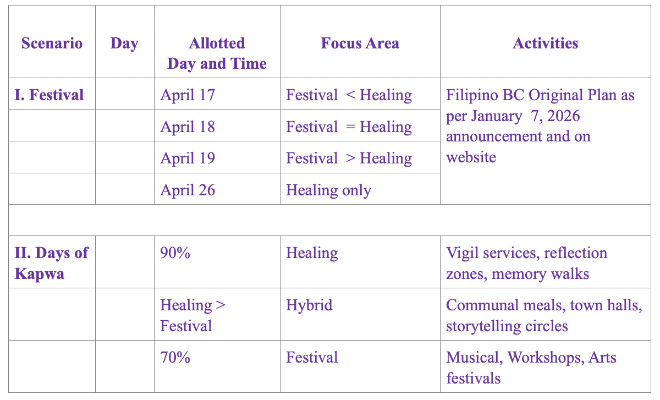
Pending results on risk assessment on Filipino B.C.’s anniversary plan (Scenario I in Table below), an alternative proposed scenario (Scenario II – Days of Kapwa in Table below) is envisioned to reflect the medical tenet Primum Non Nocere (First, Do No Harm) and the wisdom of trauma experts and bioethical first principles. This proposal prioritizes the "most vulnerable” members of the community over the "most active."
Tabulated Representation of Scenario I and Scenario II
[Note: ‘Festival’ to mean traditional celebrations and ‘Healing’ to mean community vigils and other memorial activities]
An 8-Week Framework for Healing from the Mandate, ‘First Do No Harm’
For the next eight weeks, adopt a new framework that is rooted in the medical principle ‘Primum non nocere’ (First, do no harm). And couple that with trauma-informed recovery model which empowers victims and their families to share in decision-making. Below is a proposal for consideration by all concerned:
Phase 1: Facilitated Dialogue with a Mediator
Within the next 10-14 days, re-gather the parties – Filipino BC, the victim families, and the former board members – for a dialogue with a neutral mediator on the following agenda:
- Release of a preliminary audit or transparency report by an independent auditor showing direct aid versus endowment. This will help resolve the gap in trust about disbursements and "ethical breach".
- Statement from the Vancouver Foundation. This will clarify the nature of the endowment fund. It will help explain whether endowment funds can be ‘unlocked’ if community consensus gives priority to immediate relief. It will help clarify intent of donors and allotment of funds when considering between health needs of victims’ families and building a facility. It will resolve the feeling of being misled or ignored during their time of acute financial need.
- Detailed discussion of events to allow for collaborative choice. Having a direct voice in shaping the planned events avoids potential triggers for re-traumatization.
Phase II: Environmental Safety
If the January 7 programming plan had passed risk assessment, then there will be reassurance to accept Scenario I as discussed above. If not, then the gathered can consider Scenario II.
Indeed, there is a time for the Bayanihan spirit of a street festival, and there is a time for the Pagdadalamhati (deep mourning) of a cemetery-like scene. We must not confuse the two realities.
Phase III. A Final Commitment - Path of Accord and Accountability
The first-year anniversary will be a test of our community's character. Will we ignore the social friction and prioritize the "look" of a successful event to ‘celebrate resilience’ or acknowledge and address the friction and the "feel" of a safe one to ‘respect active mourning’ ?
We must assure the families of the eleven that we see and feel the friction, that our first priority is to do no more harm – primum non nocere, and that we commit to a path of accord and accountability.
A Summons for Sensitivity and Humility
Navigating the first-year anniversary of the LapuLapu tragedy summons the best in us: infinite sensitivity and humility-laden leadership. Let our recovery be defined not by the friction that pulls us apart, but by the radical transparency that brings us together. This is the way toward assured Paghilom (Healing), not by moving on alone but by moving forward together, assured by facts and figures, fostered by trust, and illumined by the light of transparency.
Editor's note: Dr. Rey D. Pagtakhan, P.C., O.M., LL.D., Sc.D., M.D. M.Sc. is a retired lung specialist, professor of child health, and former MP, Parliamentary Secretary to the Prime Minister, and cabinet minister. He graduated from the University of the Philippines, did postgraduate training and studies at the Children’s Hospitals of Washington University in St. Louis and the University of Manitoba in Winnipeg, and spent a sabbatical year as Visiting Professor at the University of Arizona Medical Center. He is the author of articles and chapters in medical journals and textbooks and columnist for community newsmagazines. Widely lectured in Canada and abroad, he spoke in June 2003 on “The Global Threat of New Infectious Diseases” at the G-8 Science Ministers/Advisors Carnegie Group Meeting in Berlin. He volunteers on the Advisory Council of Immigration Partnership Winnipeg and the Board of St. Paul’s College Foundation at the University of Manitoba.